Diesel, But Make It Rational: Reassessing the BMW 320d for the M3 Run to London
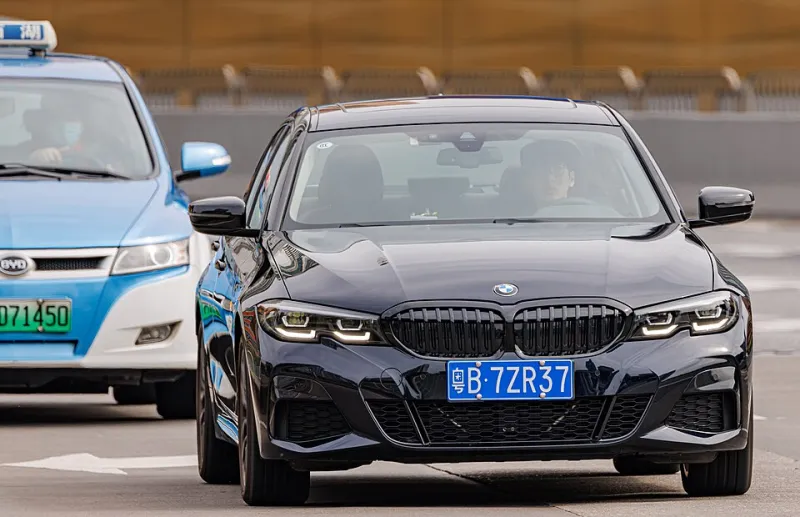
Photo: Dinkun Chen, CC BY-SA 4.0, via Wikimedia Commons
Few topics divide our customers quite like diesel. One fortnight a Basingstoke buyer will tell us it is dead technology; the next, a commuter from Chineham will drive away in a 320d Touring, delighted with 55 mpg on the run into the capital. Both are, in their way, correct — which is why the question deserves a proper answer rather than a soundbite.
The Commute Hasn't Changed, But the Rules Have
The journey from Basingstoke to central London remains roughly 48 miles each way, much of it along the M3 corridor through Hook, Sunbury and onto the A3 or into town. For a driver making that trip three or four times a week, annual mileage quickly climbs past 15,000 — territory where powertrain choice stops being a matter of fashion and becomes a matter of arithmetic.
The ULEZ expansion of 2023 was the turning point for many. The good news, and it is genuinely good news: every modern BMW diesel we sell meets Euro 6 standards and is fully ULEZ-compliant. The £12.50 daily charge simply does not apply to a 320d registered after September 2015. What ULEZ removed is not diesel's viability, but diesel's excuse for being dirty — and BMW's current engines cleared that bar comfortably.
Running Costs: Where the Numbers Settle
Let us be concrete. A 320d saloon driven briskly but honestly on the M3 will typically return 50–55 mpg in mixed use, and more if the driver resists the temptations of the right foot. A 330e plug-in hybrid, by contrast, is superb if charged nightly and used mostly on short urban legs — but on a motorway commute running on petrol, real-world figures closer to 40 mpg are common, and the petrol engine must be fed premium fuel to perform at its best.
Over 15,000 miles a year, that difference compounds into hundreds of pounds. Add the fact that diesel currently sits at a modest premium to petrol at the pumps, and the 320d's case strengthens further for high-mileage drivers. Company car users should look the other way — Benefit-in-Kind treatment still heavily favours electrified powertrains — but for private buyers paying their own fuel bills, the diesel remains the accountant's friend.
Residual Values: The Quiet Argument
Depreciation is the largest cost of owning any premium car, and here diesel BMWs have settled rather than collapsed. The used market has found its level: clean, high-specification 320ds hold values remarkably well precisely because the audience for them — long-distance drivers — knows exactly what it wants. Petrol equivalents of the same vintage often undercut them on used forecourts, which tells you where demand sits for the motorway crowd.
Electric alternatives present a different risk profile. The i4 is an outstanding car, but rapid technological turnover means earlier EVs can shed value quickly as range figures improve. A diesel's residual value is, if anything, more predictable in 2025 — and predictability matters when you are committing to a finance agreement.
The Drive: Why the 320d Still Feels Right
Numbers aside, there is the matter of the drive itself. BMW's 2.0-litre turbodiesel delivers 485 Nm of torque — more than many petrol sixes — which translates into effortless motorway cruising and the ability to overtake a slow-moving caravan near junction 5 without a downshift drama. Refinement at a 70 mph cruise is superb; the engine barely whispers above 1,500 rpm.
An i4 covers the same ground in silence, admittedly, and for drivers who can charge at home and whose commute ends at a destination with charging, it is a genuinely compelling alternative — our earlier assessment of the i4 and iX for Basingstoke drivers covers that ground in detail. But the public charging network between Basingstoke and London still requires planning, and motorway services charging on a wet Friday evening remains a lottery no diesel driver has ever had to enter.
Our Verdict for the M3 Corridor
If your annual mileage is under 10,000, your driving is mostly town-based, or you can charge at home, a petrol or electrified BMW makes more sense in 2025 — and we will happily show you the 330e or i4. But if you are commuting to London three or more times a week, paying your own fuel, and planning to keep the car beyond a typical PCP term, the 320d remains the most rational choice in the BMW range. It is ULEZ-compliant, refined, torque-rich and — perhaps most importantly — thoroughly proven.
The best way to settle the debate is to drive both. Our Basingstoke team keeps a representative spread of 320d, 330e and i4 vehicles for exactly this comparison, and we would rather you left with the right answer than the fashionable one. Book a test drive, bring your commute, and let the M3 make the argument for you.