Specification Sense: Which BMW Options Basingstoke Owners Actually Use — and Which Gather Dust
Walk along any BMW forecourt and a familiar calculation is under way at every car: what did the first owner specify, and was the money well spent? Few manufacturers offer a longer options list, and the distance between a sensible specification and an indulgent one can be considerable. After enough handovers in Hampshire, patterns begin to emerge. Certain extras are used on virtually every journey. Others are discovered for the first time on the morning the keys are handed back.
Two cars, one badge, very different daily lives
A 320i in Sport trim and a 320i with a carefully chosen set of options are the same car on paper and quite different machines to live with. The distinction matters most in the used market, where specification frequently decides which of two similarly priced cars a buyer chooses. It also matters to the person paying monthly, because options are rarely free and their effect on the residual value is uneven. Some are rewarded at resale. Some are politely ignored.
What follows is not a plea for a fully loaded car. It is an attempt to separate the useful from the merely impressive.
Five extras that earn their keep
Heated seats and a heated steering wheel
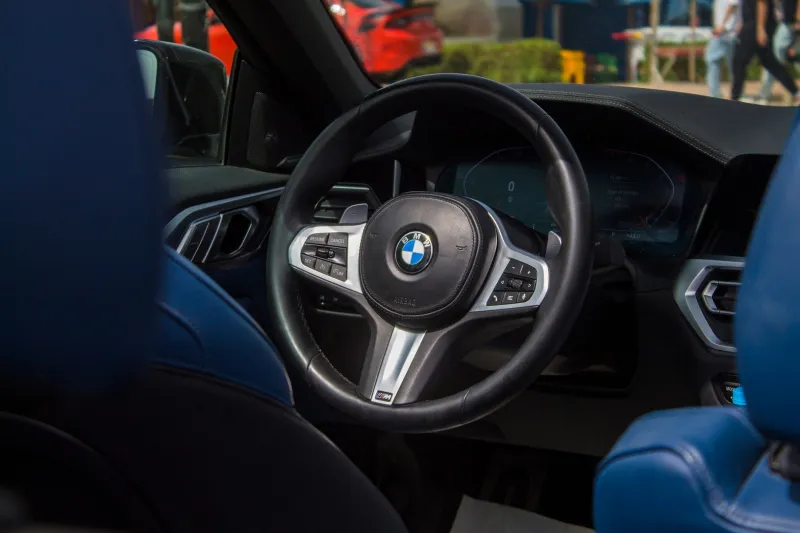
Hampshire winters are seldom dramatic, but they are long, damp and persistent. A cold leather seat at seven in the morning in RG21 is a genuine discomfort, and a heated steering wheel is one of those features that sounds indulgent until the first frosty week. Of all the options discussed at handover, these are among the most frequently mentioned unprompted by owners months later.
Parking sensors and a reversing camera
Basingstoke's older residential streets, the multi-storey at Festival Place and the tight bays outside any number of Chineham and Hatch Warren homes make low-speed manoeuvring a daily event. Sensors and a camera do not compensate for poor observation, but they reduce the small scrapes that cost far more than the option did. Park Assist, which will steer into a bay, is a pleasant bonus rather than a necessity.
Driver assistance: adaptive cruise and lane keeping
The M3 commute is rarely a flowing drive. Average-speed roadworks, stop-start traffic near the Thames Valley and long stretches at a steady 50mph are precisely the conditions in which adaptive cruise control proves its worth. Lane-keeping assistance, meanwhile, earns its place on the A34 at dusk. Buyers who spend four or five hours a week on motorway tarmac consistently rate this among their better decisions.
An upgraded audio system
Larger alloy wheels and coarse motorway surfaces generate a good deal of road noise, and a standard system can struggle against it. The premium audio upgrades offered across the BMW range are not cheap, but for anyone covering serious mileage between Basingstoke and London, Reading or Southampton, the difference is audible every day rather than occasionally.
A head-up display
This one divides opinion until it is lived with. Projecting speed and, where fitted, navigation prompts into the driver's line of sight reduces the small repeated glances downward that accumulate on an unfamiliar route. On the approach to junction 6 or through the roadworks on the A33, that marginal gain in attention is worth more than it sounds.
Three extras that quietly retire
The panoramic glass roof
The first fortnight is delightful. After that, the blind tends to stay closed, particularly in summer when the cabin already warms quickly. It adds weight high in the car and, in some specifications, a modest amount of complexity. It photographs beautifully and sells a car on the forecourt, but it is seldom used in the way buyers imagine.
Gesture control
A clever demonstration and a rarely used function. Most owners revert to the rotary controller or the touchscreen within weeks, finding them quicker and more precise. It is a feature that impresses passengers once and then fades into the background.
Rear-seat entertainment
Tablets and phones have largely taken over this role. Unless the car regularly carries children on long journeys and the family prefers a fixed system to a headrest mount, the money is usually better directed elsewhere.
What part-exchange reveals
When a car comes back to us, the valuation conversation is rarely about the sunroof. It is about mileage, condition, service history, colour and a handful of desirable features: heated seats, a decent camera setup, driver assistance and a strong audio system. Options that age gracefully tend to be the ones that address a recurring irritation rather than a one-off novelty.
This is worth remembering when comparing two nearly identical used BMWs. A modest premium for a well-chosen specification is often better value than a larger discount on a car with an expensive but rarely used options list.
A sensible order of spending
If the budget will not stretch to everything, a practical sequence suggests itself. Begin with comfort and visibility: heated seats, parking aids, a head-up display. Then address the miles you actually cover: driver assistance for motorway work, upgraded audio if you spend long hours behind the wheel. Consider styling additions last, once the functional ground is covered.
The short version
Options should answer a question you genuinely ask every week. Heated seats, parking aids, adaptive cruise and a good sound system answer questions that Basingstoke drivers ask constantly. A glass roof and gesture control answer questions nobody asked. Specification is a personal matter, but it is rarely a mystery — the pattern of daily use tends to reveal itself well before the trade-in conversation begins.