One Garage, Two Commuters: Sharing a Single BMW Between Basingstoke and London
There is a moment in many Hampshire households when the second car stops justifying itself. It sits on the drive for four days out of seven, accumulates insurance, tyres and MOT appointments, and quietly depreciates. The question that follows is whether one BMW can genuinely cover two people's working lives. Sometimes the answer is yes. Sometimes it is a compromise dressed up as a saving.
Two commutes that are not remotely alike
Consider a representative pair. One partner travels from Basingstoke to London four days a week, either driving the M3 eastbound or taking the train from Basingstoke station. The other works in Reading, a journey of roughly twenty miles along the A33 or via the M3 to junction 11, made at a different hour and often with equipment in the boot.
The London journey is longer but more predictable. The Reading journey is shorter but frequently involves stop-start traffic through Sherfield, Mortimer and the approaches to the town centre. One is a steady motorway cruise; the other is a series of short urban runs. A car that suits both needs a broader range than either journey alone would demand.
The train deserves fair consideration. A season ticket from Basingstoke to Waterloo removes the wear entirely, and the car then becomes the Reading partner's vehicle for most of the week. Many households reach exactly this arrangement, and it is often the most economical answer.
Making one cabin fit two drivers
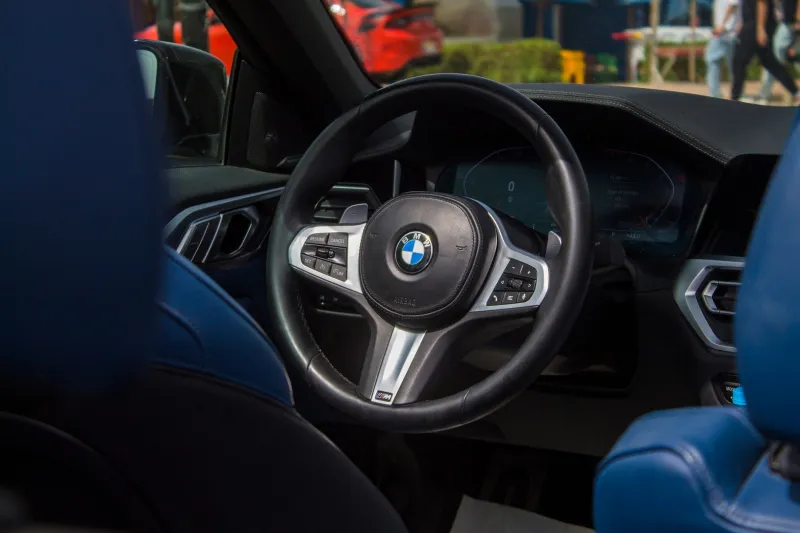
This is where modern BMWs are far better than their reputation suggests. Seat and mirror memory is not a luxury in a shared car; it is the difference between a comfortable journey and fifteen minutes of fiddling. Where the specification includes memory seats, the settings extend to the door mirrors and often the steering column.
Driver profiles take this further. Stored through the car's iDrive system and linked to a key or a registered profile, they can carry climate preferences, audio favourites, navigation destinations and assistance settings. Two keys, two profiles and a brief conversation at the outset will save endless minor adjustments.
It is worth setting this up deliberately rather than discovering it by accident. A short session with the car before the shared arrangement begins, saving both positions and confirming which key belongs to whom, prevents most of the friction that shared cars otherwise generate.
Fuel, charge and the weekly routine
For a petrol or diesel BMW, the routine is straightforward: one refuelling stop a week, perhaps two for the London driver, and a shared understanding about who fills the tank. It sounds trivial until the first month ends with an argument about receipts.
For an electric or plug-in hybrid car, the routine needs more thought. Home charging overnight suits the London pattern well — a long, steady motorway journey followed by hours on the drive. The Reading pattern, with many short trips, actually suits electric running even better, provided the car is plugged in whenever it is stationary rather than treated like a petrol car that occasionally visits a charger.
The practical rule is simple: whichever driver returns home last plugs the car in. A shared charging log, whether an app or a note on the kitchen board, avoids the situation where both drivers assume the other has done it.
Servicing when the mileage accumulates
Two drivers mean the annual mileage arrives faster. BMW's condition-based servicing adapts to use, so a car covering eighteen thousand miles across two commutes will ask for attention sooner than one covering eight thousand. Brake wear also tends to rise with urban work, and tyres on the heavier models will want checking more often than the handbook suggests.
Budgeting monthly for servicing rather than reacting to the dashboard warning is the difference between a routine booking and an inconvenient one. It is also worth keeping a simple record of which driver covered which miles, if only to explain the pattern of wear at resale.
Insurance, tax and the paperwork
Adding a second named driver to an existing policy is usually cheaper than a second policy, though the arithmetic is not automatic and depends on both drivers' histories. Where the two people have very different no-claims records, separate policies can occasionally make more sense, since each protects its own discount. Mileage declarations should reflect the combined total honestly; under-declaring to reduce a premium is a false economy at claim time.
Vehicle tax, MOT and breakdown cover are all shared costs, and the savings against running two cars are real and immediate.
The honest trade-offs
One car means coordination. There will be a Tuesday when both people need the vehicle, and the resolution will involve the train, a lift or a rearranged meeting. It also means every stone chip, kerbed alloy and parking dent is felt by both parties.
Against that, the financial case is compelling. Insurance, tax, servicing, tyres, depreciation and parking are all halved in effect. Whether that outweighs the occasional inconvenience is a question each household must answer for itself, and the answer often changes as working patterns do.
A middle path exists: keep the BMW as the primary car and add a modest second vehicle for short local journeys. It is less elegant, but it preserves flexibility without duplicating the cost of a premium car.
Who it suits
A single BMW works best when one commute is by train, when working hours differ enough to stagger demand, and when both drivers are content to plan a week ahead. It suits least when both partners need a car at unpredictable times. For many Basingstoke households, the arrangement is not a compromise at all but a rational response to two lives that overlap for only part of the week.